
The Social Media Sales Funnel: From Follower to Customer
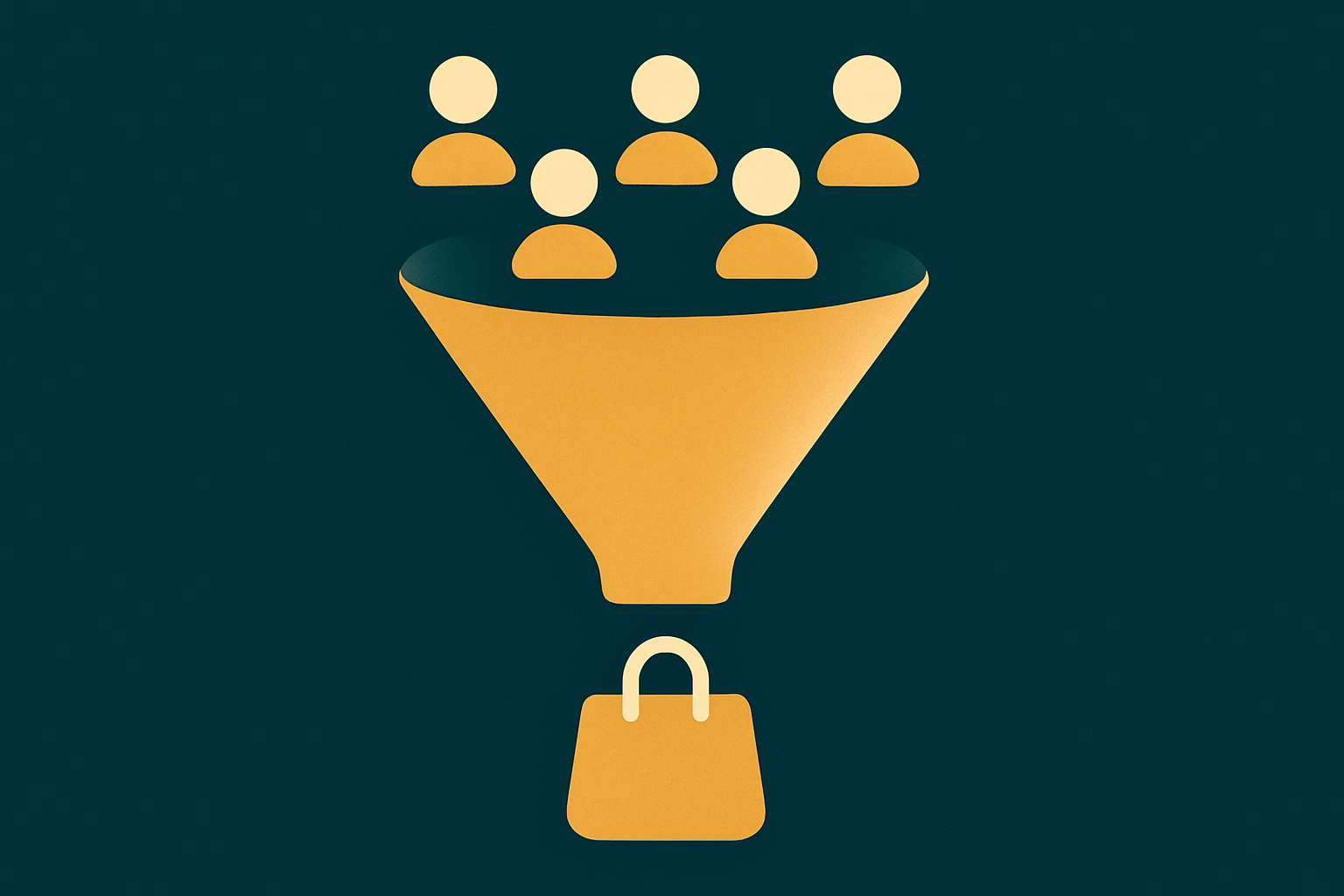
The social media sales funnel is the journey that takes a stranger from first seeing your content to becoming a customer who buys and returns. Most people fail at selling on social because they ask for the purchase from the first moment — like proposing marriage to someone you just met. In this guide you'll understand the funnel stages, what content suits each stage, and how to turn followers into customers naturally, not annoyingly.
What is the sales funnel?
The funnel is a metaphor for the customer journey: at the top many people discover you for the first time, and as we go down the number shrinks but intent grows, until a minority reaches the bottom — the actual customers. Your job is to move people from stage to stage with content suited to each step. Understanding the funnel lets you know who you're talking to now and what to say.
The four funnel stages
The classic funnel has 4 stages: Awareness (people discover you), Interest (they start to care and trust), Desire (they want what you offer), and Action (they actually buy). Each stage needs a different content type and tone. The common mistake is talking to someone at the awareness stage with action-stage language, so they bounce before they even know you.
Awareness stage: content that attracts
Here your goal is for the largest number of the right people to discover you. Suitable content: educational, entertaining, or inspiring — something that grabs attention and offers value without asking for anything. Short videos and shareable posts work best here. At this stage you give without taking, to build a first relationship and earn the attention you'll build the rest of the journey on.
Interest stage: build trust
Now people know you, they need to trust you. Suitable content: success stories, customer reviews, behind-the-scenes, and content proving your expertise. Trust is the real currency on social — people buy from whom they trust. At this stage you move the follower from "I know them" to "I trust them", the bridge they must cross before considering a purchase.
Desire stage: show the value
Here you clarify to the customer how your product or service solves their problem specifically. Suitable content: product explanations, before-and-after, comparisons, and answering their potential objections. You turn "I trust you" into "I need this". Focus on the benefit they'll get, not just product specs. When the customer sees themselves in the result you offer, desire is generated naturally.
Action stage: a clear call
The customer is ready, let them take the step easily. Suitable content: a clear offer, an explicit call to action (order, buy, book), and making the step as easy as possible. Any complexity or vagueness here loses you a sale that was ready. Tell the customer exactly what to do and where, and remove any barrier between them and the purchase. Clarity at the action moment turns desire into a decision.
After the sale: loyalty and repeat
The funnel doesn't end at the first sale. A customer who bought once is easier and cheaper to sell to again than acquiring a new one. Care for them after the sale: follow up on their satisfaction, offer value, and encourage them to return and recommend you. Satisfied customers turn into free marketers who bring you new customers. Loyalty is what turns scattered sales into a sustainable business.
The right content type for each stage
Distribute your content across stages: lots of awareness content at the top (attracts), trust content in the middle (convinces), and offer content at the bottom (sells). The mistake is for all your content to be "buy now" — that talks only to the 5% who are ready and ignores the 95% still discovering you. A balanced funnel feeds every stage so people keep moving to the bottom continuously.
The biggest mistake: selling directly from the first moment
The top reason for failing to sell on social is the page owner selling all the time without building awareness or trust. This makes people ignore you or unfollow. Imagine someone meeting you and immediately asking for money — that's exactly what you do when you sell to people who don't know you yet. Build the relationship first, and the sale comes naturally as a result.
Why followers alone aren't enough
Lots of followers without a funnel = fame without sales. There are accounts with hundreds of thousands selling little, and small accounts selling well because they have a converting funnel. The follower is the raw material, and the funnel is the factory that turns them into a customer. If you focus only on growing followers without a funnel, you fill the top and leave the bottom empty.
Read the funnel by the numbers
Track each stage with a number: how many reached you (awareness)? How many engaged or visited your profile (interest)? How many asked or clicked the link (desire)? How many bought (action)? When you see where the biggest leak is, you know where to focus your effort. If many ask but few buy, the problem is in the purchase step, not the content. Numbers show you the funnel's hole.
Follow up with leads
Not everyone buys from the first interaction. Whoever showed interest (asked, saved, followed) needs gentle follow-up moving them to the next step. An organized inbox and fast replies turn interest into a sale before it cools. Many lose ready customers due to a late reply or a lost message. Organized follow-up closes the sales the funnel brought to the purchase door.
A practical funnel example for a small store
An accessories store: Awareness — a short reel about outfit style. Interest — a post about product material and customer reviews. Desire — a "before and after" video showing the product in real life. Action — a story with a limited offer and a direct order link. Loyalty — a thank-you message after purchase and a discount code for the next order. Each step moves the customer smoothly to the next.
Common funnel mistakes
- Selling directly without building awareness and trust.
- Content all in one stage (all selling or all value).
- Neglecting after-sale and losing the old customer.
- Not following up with leads quickly.
- Measuring followers instead of funnel stages.
Accelerate the funnel with limited offers
Sometimes the customer is at the desire stage but postponing the decision. A time- or quantity-limited offer gives them a push to move now instead of tomorrow. Scarcity and urgency are strong motivators that close pending sales. But use them honestly — a fake, repeated offer burns your trust. Make the urgency real and it works, and the customer respects that you honor your word on offer deadlines.
Test and improve each stage
The funnel isn't built once and forgotten, it improves continuously. Try a different content type at the awareness stage, a different call wording at action, and watch the numbers. Each small improvement in a stage compounds its impact at the bottom. Accounts that sell well treat their funnel as an ongoing experiment they learn from, not a fixed template. Improve the weakest stage first, because it determines the whole funnel's result.
Conclusion
The sales funnel turns a stranger into a customer through a journey: awareness attracts, trust convinces, desire motivates, an easy action sells, and loyalty repeats. Distribute your content across stages instead of selling directly, and track your numbers and customers. Let Go Social AI help you plan each stage's content, manage your engagement and measure your results, and try it free to build a funnel that sells while you sleep.
Related articles
Social Media Crisis Management: A Ready Plan to Protect Your Brand's Reputation
A social media crisis management guide: a prior plan, a response team, continuous monitoring, and a fast thoughtful reply.
How to Build a Complete Content Plan Step by Step (Free Template)
A guide to building a complete content plan: monthly goals, content pillars, an idea bank, a time calendar, and periodic review.

Community Management: How to Reply to Comments & Messages Professionally
A practical guide to managing your social media community: fast replies, handling criticism, and building a real relationship with your audience.